

Current-carrying copper blocks, also known as copper conductive blocks, are core components in electrical equipment, primarily functioning to conduct electricity, thereby facilitating efficient energy transmission. These blocks are widely used in high-current and high-voltage environments, such as power equipment, motors, generators, and transformers. The excellent electrical conductivity of copper makes it an indispensable choice for situations requiring efficient current transmission.
Advantages of Current-Carrying Copper Blocks
- Excellent Conductivity
Copper has an extremely low resistivity, second only to silver, allowing it to transmit more current under the same conditions without generating excessive heat. Consequently, current-carrying copper blocks can maintain stable operation in high-current environments, enhancing system efficiency and safety. - Outstanding Mechanical Strength
In addition to superior conductivity, current-carrying copper blocks exhibit excellent mechanical strength. They can maintain stability under high stress and load conditions, resisting deformation or damage, thus ensuring long-term reliability of electrical equipment. - Excellent Corrosion Resistance
Copper forms a protective oxide layer in the atmosphere, effectively shielding the internal metal from corrosion. This allows current-carrying copper blocks to perform well in various environments, reducing maintenance and replacement frequency. - Good Machinability
Copper has excellent ductility and plasticity, enabling it to be manufactured into various shapes and sizes through forging, cutting, welding, and other processing methods to meet the demands of different applications.
Selection of Current-Carrying Copper Blocks
Choosing the right current-carrying copper block involves considering multiple factors, including current magnitude, working environment, installation method, and material type. Here are some key points to consider:

- Current Magnitude
Select the cross-sectional area and length of the copper block based on the circuit design’s current magnitude to ensure it can withstand the current without overheating. Typically, the cross-sectional area can be calculated using current density to ensure minimal heat generation during operation, thus maintaining device performance and safety. - Material Type
Different copper alloys, such as brass and red copper, can be selected based on requirements. Brass offers higher mechanical strength and wear resistance, while red copper is renowned for its excellent conductivity and corrosion resistance. Additionally, the copper block’s surface can be treated with tin or nickel plating to enhance corrosion resistance and electrical contact reliability. Tin-plated copper blocks are suitable for oxidation prevention, while nickel-plated copper blocks are ideal for high-temperature and corrosive environments. - Working Environment
Consider the ambient temperature, humidity, and potential chemical exposure of the current-carrying copper block’s environment. Choose copper alloy materials and surface treatments with appropriate environmental resistance. For example, in high-temperature environments, red copper with nickel plating can be selected for improved corrosion resistance. - Cost-Effectiveness
Choose materials and processes that are economically reasonable while meeting technical requirements to maximize economic benefits. For cost-sensitive projects, brass can be selected, and material usage can be optimized to reduce costs.
Applications of Current-Carrying Copper Blocks in High-Power Product Upgrades

- Performance Enhancement
Current-carrying copper blocks can significantly improve the conductivity efficiency and stability of equipment, while their mechanical and corrosion resistance can enhance overall product reliability. For instance, in electric vehicles and high-performance audio systems, using high-quality current-carrying copper blocks can greatly improve energy transmission efficiency, reduce energy loss, and extend product lifespan. In electric vehicles, the battery system’s performance directly impacts the vehicle’s range and lifespan. By adopting high-performance current-carrying copper blocks, internal resistance can be effectively reduced, minimizing energy loss and enhancing the electric vehicle’s range and overall performance. Additionally, the excellent heat dissipation of current-carrying copper blocks helps prolong battery life by reducing overheating-related failures. - Elevating Product Quality
The use of current-carrying copper blocks can significantly elevate product quality. By selecting nickel- or tin-plated copper blocks, not only can durability and aesthetics be improved, but the professionalism and quality of the product can also be showcased in high-end markets. For example, high-end home appliances and smart home devices that use premium current-carrying copper blocks not only enhance internal performance (conductivity, heat dissipation, stability) but also become more competitive in appearance and texture. In high-end audio equipment, nickel-plated current-carrying copper blocks can enhance audio signal purity, reducing signal loss and interference, thereby providing a higher quality audio experience. Furthermore, nickel plating offers greater corrosion resistance and aesthetic appeal, making the entire audio system appear more upscale and professional.
Design and Production Methods for Current-Carrying Copper Blocks
In practical applications, current-carrying copper blocks can be used in various ways to ensure efficient current conduction and heat dissipation:
- Direct Contact
Directly welding or attaching the copper block to the pins or bottom of the heating element creates a direct thermal conduction path. This method quickly and effectively transfers heat from the heating element to the copper block, reducing heat accumulation and enhancing device stability and longevity. - Thermal Vias
Designing thermal vias on the PCB allows heat to be transferred from the copper block to the other side of the PCB or a heat sink. This method effectively utilizes the multi-layer structure of the PCB to disperse and transfer heat, improving overall heat dissipation capability. - Copper Pour
Applying a large area of copper foil on the PCB increases overall heat dissipation capability. This method enlarges the cooling area, lowers local temperature, and ensures stability and safety of the circuit board in high-current operating environments.
Specific Application Cases of Current-Carrying Copper Blocks
In the industrial and power storage fields, there are many successful cases of applying current-carrying copper blocks. For example, a new generation of outdoor power supply produced by a customer in the outdoor energy storage sector uses welded copper strips to increase load and improve heat dissipation, significantly enhancing performance and aesthetics.
Another case involves the design of a high-performance electric vehicle, where optimizing the shape and material of the current-carrying copper block significantly improved the conductivity and heat dissipation of the battery system, thereby extending battery lifespan and driving range. By using higher conductivity red copper and applying nickel plating, the battery system of the electric vehicle can maintain stable energy transmission under high loads, significantly enhancing overall vehicle performance and user experience.

Other High-Power Hardware Components Besides Current-Carrying Copper Blocks
In addition to current-carrying copper blocks, welded terminals, PCB insert clips, and surface mount nuts are widely used in industries such as power, electrical, electronics, and automotive. Here are some product highlights:
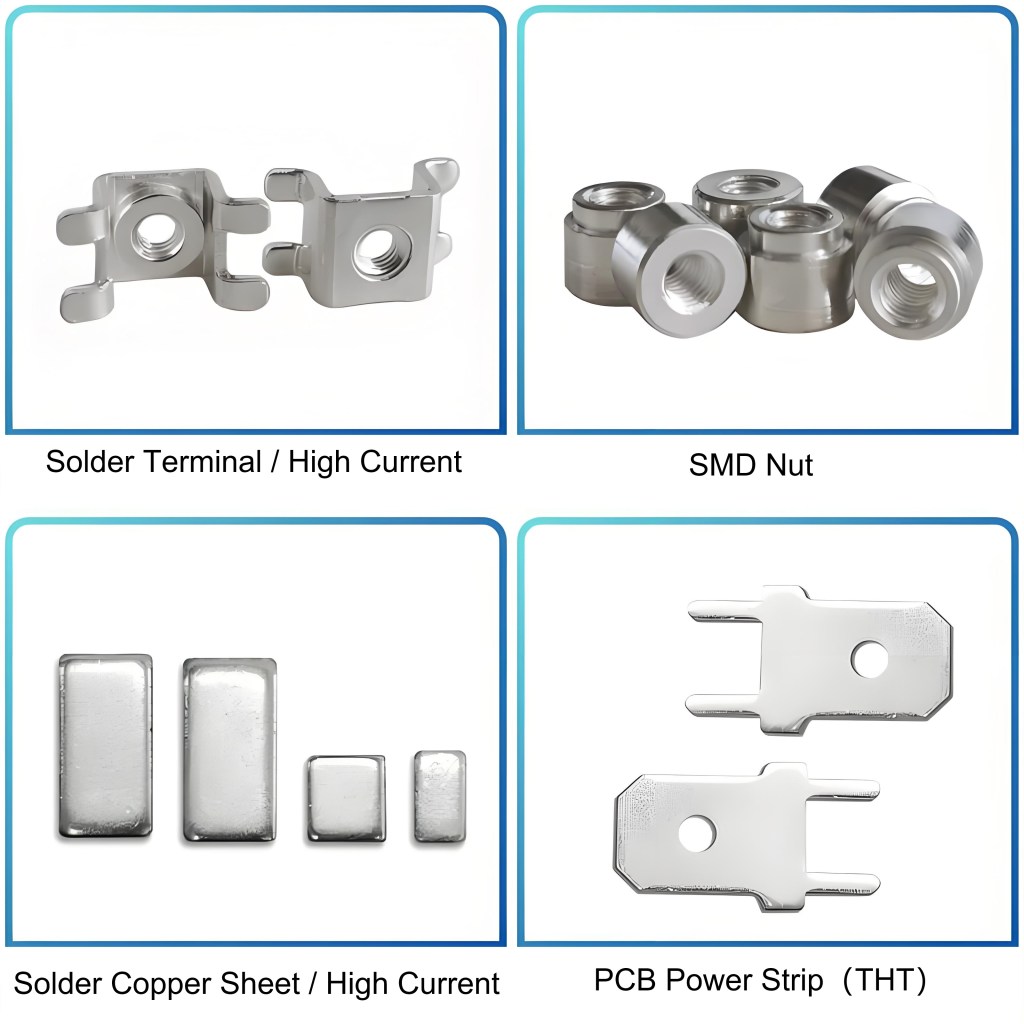
- Current-Carrying Copper Blocks
Surface mount current-carrying copper blocks are made from high-purity copper materials (brass or phosphor bronze) and undergo rigorous processing and quality control to ensure excellent conductivity and mechanical strength. Various specifications and surface treatments of copper blocks are available to meet different customer needs. - Welded Terminals
Welded terminals are important components in electrical connections, featuring good conductivity and mechanical connection strength suitable for various electrical devices and circuit connections. - PCB Insert Copper Plates
PCB insert copper plate products have excellent conductivity and stable mechanical strength, widely used in various high-current, high-voltage circuit designs to ensure efficient energy transmission and safe operation of devices. - Surface Mount Nuts
Surface mount nuts are essential components for securing and connecting electronic components, with various specifications and materials customizable to meet different customer needs.
This concludes our knowledge and experience sharing regarding current-carrying copper blocks in high-power hardware design projects. We hope this information serves as a technical reference for engineers during the design and production phases. If you have any questions or are interested in current-carrying copper block products, feel free to leave us a message. We are happy to discuss the clever applications of current-carrying copper blocks with you!

 Everything About PCBA Electronic Manufacturing